German possessive articles: mein, dein and ihr
German possessive articles show who something belongs to. Choose the stem for the owner, then the ending for the gender, number and case of the noun.
What this guide covers
- Choose the owner
- Declension with mein
- Euer, ihr and Ihr
- Check your sentence
Choose the owner
The stem describes the person who owns something; its ending agrees with the thing owned. In sein Bruder and seine Schwester, the owner stays the same. The different endings reflect the nouns, not a change of owner.
| Owner | Possessive stem | Meaning |
|---|---|---|
| ich | mein- | my |
| du | dein- | your, informal singular |
| er / es | sein- | his / its |
| sie (singular) | ihr- | her |
| wir | unser- | our |
| ihr | euer- | your, informal plural |
| sie (plural) | ihr- | their |
| Sie | Ihr- | your, formal |
Declension with mein
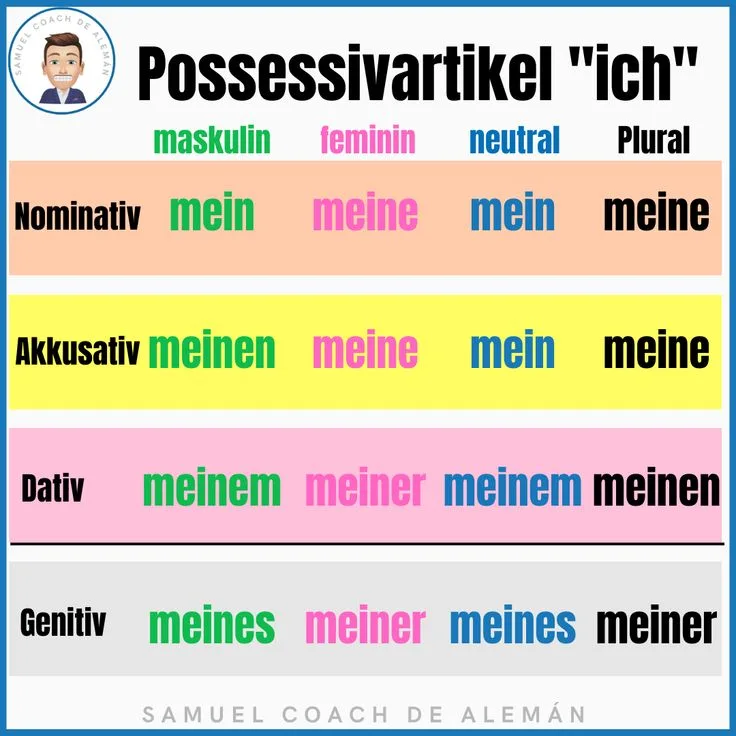
Possessive articles follow the ein-word pattern. Unlike ein, they also have plural forms. Learn one set of endings and use it with the other stems.
| Case | Masculine | Feminine | Neuter | Plural |
|---|---|---|---|---|
| Nominative | mein | meine | mein | meine |
| Accusative | meinen | meine | mein | meine |
| Dative | meinem | meiner | meinem | meinen |
| Genitive | meines | meiner | meines | meiner |
Compare Das ist mein Bruder with Ich sehe meinen Bruder. The second sentence has an accusative object. In mit meinen Freunden, the dative plural noun also takes -n.
Euer, ihr and Ihr
The usual declined forms of euer lose the second e: eure Schwester, euren Bruder, eurem Kind. Lowercase ihr can refer to her or their possessions. The formal possessive Ihr stays capitalized within a sentence. At the beginning of a sentence, a capital letter alone does not distinguish formal Ihr from sentence-initial ihr. Context distinguishes her from their.
- Er hilft seinem Freund. — He helps his friend.
- Wir fahren mit unserem Auto. — We are travelling in our car.
- Haben Sie Ihren Pass dabei? — Do you have your passport with you?
Check your sentence
First identify the owner, then ask what role the noun plays. Avoid Ich sehe mein Bruder: the masculine accusative needs meinen. Practise by changing one noun from nominative to accusative and dative while keeping the same owner.
Practise in context
Use the explanations above when reading German texts and completing gap-fill exercises.