Ihr in German: you, her, their and formal Ihr
The same spelling can have several grammatical jobs. Look at the verb, the following noun and the capital letter before deciding what ihr means.
What this guide covers
- Four uses to recognize
- Three clues: verb, noun and case
- Do not confuse ihr with euer
- Try it in context
Four uses to recognize
| Use | Example | Meaning |
|---|---|---|
| Subject, informal plural | Ihr kommt morgen. | You are coming tomorrow. |
| Dative pronoun | Ich helfe ihr. | I help her. |
| Possessive article | Das ist ihr Buch. | That is her/their book. |
| Formal possessive | Ist das Ihr Buch? | Is that your book? |
At the start of a sentence, capitalization alone is not enough: Ihr kommt uses the ordinary sentence-initial capital. Formal possessive Ihr remains capitalized inside a sentence too.
Three clues: verb, noun and case
If ihr is the subject, the verb has the informal plural form: ihr seid, ihr habt, ihr lest. As a dative pronoun, ihr stands for a feminine singular noun or referent, often a female person. A verb or preposition can require this dative form: Ich spreche mit ihr. Before a noun, it is often possessive: ihr Bruder, ihre Schwester, mit ihrem Kind. The endings reflect the noun’s case, gender and number.
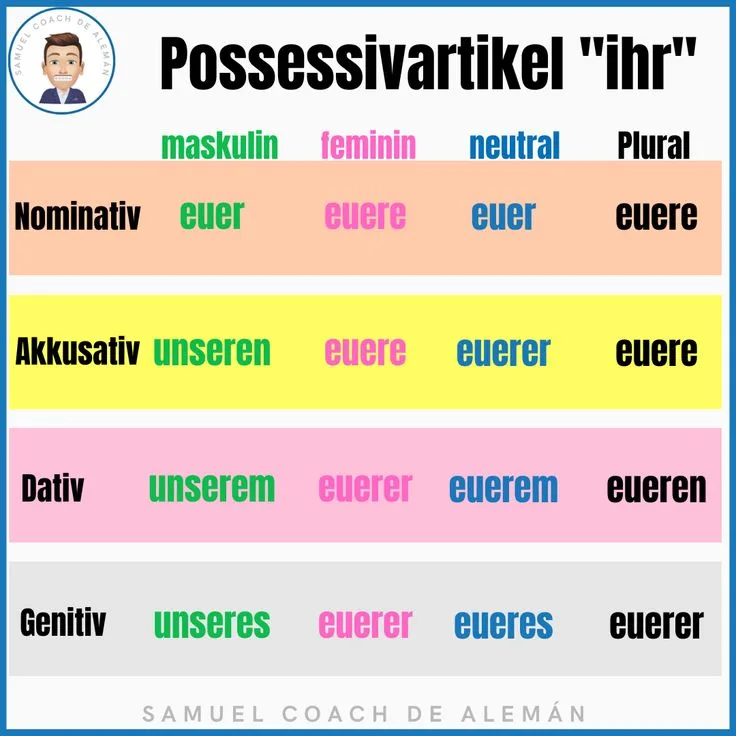
Do not confuse ihr with euer
The possessive article for informal plural you is euer, not ihr: Ihr habt euer Buch vergessen. Lowercase possessive ihr refers to her or their possessions; the context tells you which. Compare Anna sucht ihren Schlüssel and Die Kinder suchen ihren Ball.
Try it in context
- Ich gebe ___ das Buch. — Use ihr for “her”.
- Habt ihr ___ Bücher dabei? — Use eure for “your”.
- Frau Müller, ist das ___ Tasche? — Use Ihre for formal “your”.
Read the full sentence before translating. A word list cannot tell you whether ihr is a subject, an object or part of a noun phrase.
Practise in context
Use the explanations above when reading German texts and completing gap-fill exercises.