German indirect questions: ob and question words
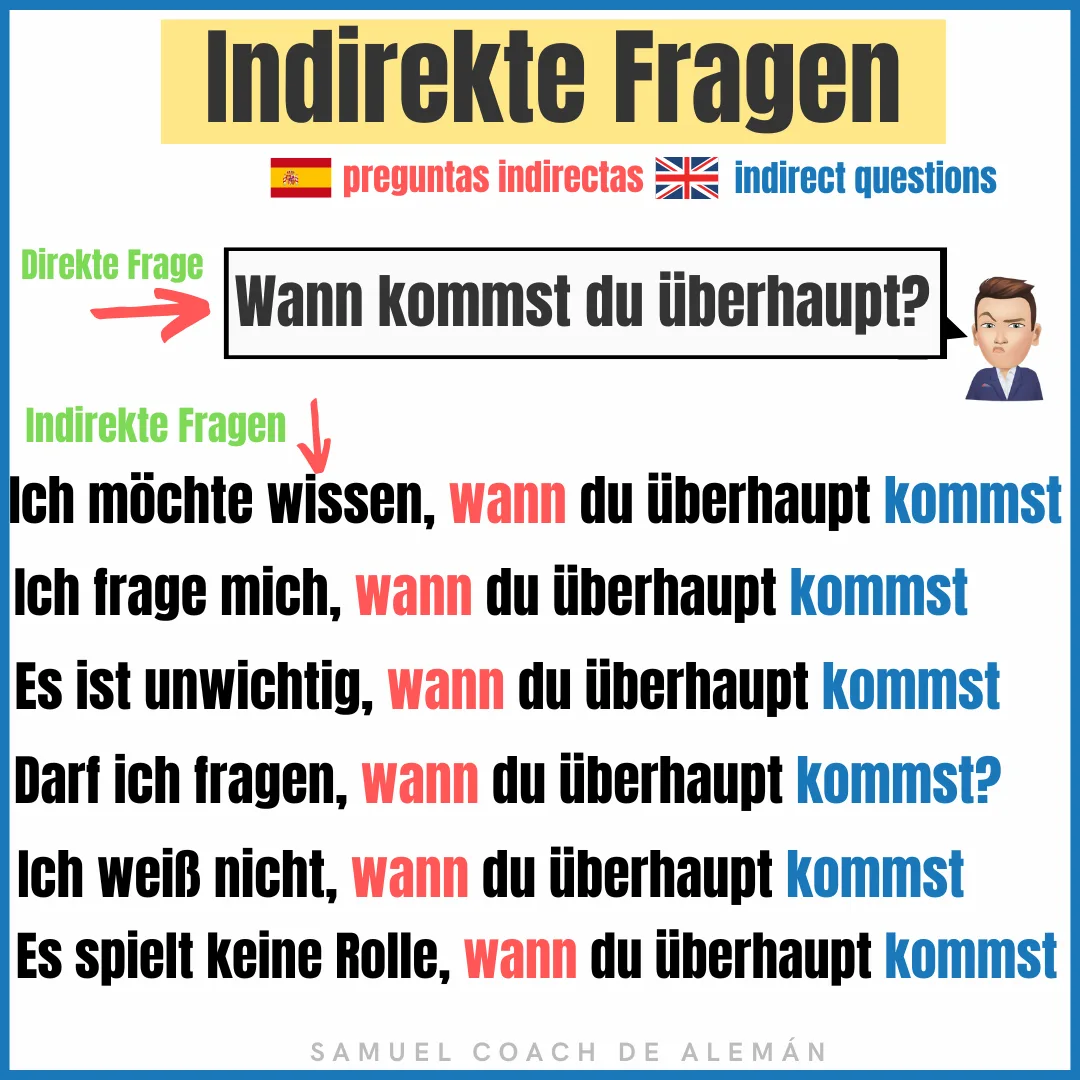
An indirect question places a question inside another sentence. Keep the question word, or use ob for a yes/no question, and move the conjugated verb to the end.
What this guide covers
- Keep the question word
- Use ob for yes/no questions
- Punctuation and useful starters
- Avoid the direct-question trap
Keep the question word
Use the original question word as the connector. The clause no longer has direct-question word order. Compare the complete sentences rather than moving only one word.
| Direct question | Indirect question |
|---|---|
| Wo wohnt er? | Ich weiß nicht, wo er wohnt. |
| Wann kommt der Zug? | Weißt du, wann der Zug kommt? |
| Warum hat er angerufen? | Ich frage mich, warum er angerufen hat. |
With a perfect tense, the finite auxiliary comes last: warum er angerufen hat.
Use ob for yes/no questions
When there is no question word, use ob, meaning whether or if. Do not replace it with conditional wenn.
- Kommt sie? → Ich weiß nicht, ob sie kommt.
- Ist das möglich? → Wir fragen uns, ob das möglich ist.
- Hat er angerufen? → Weißt du, ob er angerufen hat?
Punctuation and useful starters
Separate the embedded clause with a comma. The final punctuation depends on the whole sentence: Ich weiß nicht, wo er wohnt. is a statement; Weißt du, wo er wohnt? is a question. If the embedded clause interrupts the main sentence, close it with a second comma: Die Frage, ob er kommt, ist noch offen. Useful starters include wissen, fragen, sich fragen, sagen and erklären.
Avoid the direct-question trap
Do not write Ich weiß nicht, wo ist der Bahnhof. Write Ich weiß nicht, wo der Bahnhof ist. Practise with one question about a place, one about a time and one yes/no question, checking the last verb each time.
Practise in context
Use the explanations above when reading German texts and completing gap-fill exercises.