German imperative: du, ihr and Sie commands
Choose the imperative form according to who you are addressing. Informal singular, informal plural and formal commands have different patterns.
What this guide covers
- The three basic forms
- Vowel changes and endings
- Separable verbs and sein
- Practise with real instructions
The three basic forms
| Form of address | machen | lesen | kommen |
|---|---|---|---|
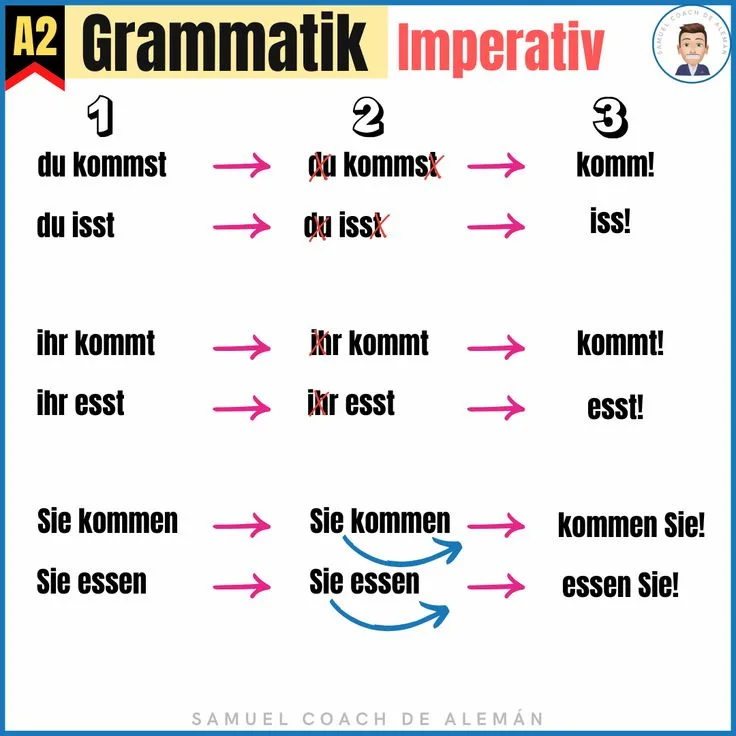
| du | Mach! | Lies! | Komm! |
| ihr | Macht! | Lest! | Kommt! |
| Sie | Machen Sie! | Lesen Sie! | Kommen Sie! |
For many du commands, start with the present-tense stem and omit the pronoun; check the vowel changes and endings below. Ihr uses the present-tense ihr form without ihr. Formal commands keep Sie after the verb. Add bitte to soften an instruction: Lesen Sie bitte den Text.
Vowel changes and endings
The e → i/ie change stays in the du imperative: sprechen → Sprich!, lesen → Lies!, nehmen → Nimm! The a → ä change does not: fahren → Fahr!, not Fähr. Some forms require or commonly take -e: Warte!, Öffne! After the e → i/ie change, do not add -e: Lies!, not Liese!
Separable verbs and sein
A separable prefix goes to the end: Mach die Tür auf!, Ruf mich an!, Steht bitte auf! The forms of sein are irregular and worth learning together.
- Sei ruhig! — du
- Seid pünktlich! — ihr
- Seien Sie vorsichtig! — Sie
Practise with real instructions
Write one instruction for a friend, one for a group and one for someone you address formally. Check whether Sie is present where needed, whether the separable prefix is at the end and whether the vowel change is correct. Avoid adding du to every ordinary imperative.
Practise in context
Use the explanations above when reading German texts and completing gap-fill exercises.